There's a specific loneliness that doesn't go away with more people. You can have a full social calendar and still return to your apartment feeling like a ghost. What you need isn't volume of interaction; it's depth of interaction — and most rooms are not built to provide it. That's not the fault of the rooms. It's a bandwidth mismatch between your chart and the average configuration of others.
Water charts feel connection at a particular depth. When conversations stay at surface altitude — news, logistics, performance, banter — the chart receives them as noise. It's not that the people are bad company. They just aren't transmitting on the frequency Water reads as connection. You can be surrounded and entirely alone.
Quick diagnostic
Does any of this sound like you?
- You leave group dinners feeling emptier than before you arrived.
- One long one-on-one conversation with the right person leaves you more nourished than five group hangs.
- You're "fine" in most social situations and quietly exhausted by the end of them.
- You've gotten "you're hard to get to know" from people who genuinely like you.
- The loneliness is worse in full rooms than in empty ones.
The BaZi lens: depth mismatch is the mechanism
Water is the element of depth. It runs at layers most charts don't habit-level access. Connection, for a Water chart, means being seen at depth — at the layer where your inner weather is actually happening. Surface rooms are not seeing you at that layer; not because they're refusing, but because they're not tuned there.
The ache isn't "no one likes me." The ache is "I'm here and I'm not being reached." Those are different problems with different fixes. The first asks you to be more social. The second asks you to change the kind of rooms you invest in.
The Five Elements
Why the room doesn't land
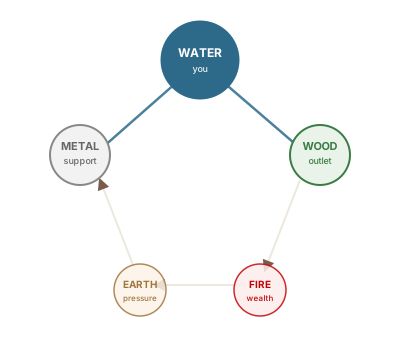
Read it like this: Water's native altitude is depth. Surface-level exchange passes through it without registering as connection. The loneliness is the gap between what your chart can receive and what most rooms transmit. The fix is different rooms, not more rooms.
Most chronic loneliness among Water charts is solved by two or three relationships that run at matching depth, not by ten more acquaintances. The quantity strategy fails Water every time. The quality strategy almost always works.
What's actually happening in your chart
Three patterns recur in deep-lonely Water charts.
One: surface performance for belonging. You've learned to operate at the room's surface altitude to belong, but your chart doesn't accept surface as connection. So you perform, get surface response, and interpret the gap between effort and nourishment as your own failure. It isn't. You're succeeding at the wrong game.
Two: hiding the depth behind function. Your close friends and partner know you're "the deep one," but your actual interior stays behind a functional persona. You process heavy things privately, present a steady outer self, and then feel unknown even by people who love you. They can't reach what you haven't opened. This is an invitation problem, not an affection problem.
Three: lacking one-on-one bandwidth. Water thrives in dyadic depth — long, uninterrupted, one-on-one time. If your social life is almost entirely groups, you are starving the specific container that feeds you. No number of group dinners replaces one three-hour walk with the right person.
When this shifts
Water loneliness resolves along predictable lines:
- One depth-matching person. The first long conversation with someone whose chart runs at matching depth fundamentally re-sets what you're looking for. The bar becomes legible, and everything else gets correctly sized. Most people can name the moment this happened to them.
- Water months of internal permission. Pig and Rat months soften the persona. You'll find yourself willing to say things you wouldn't say in June. Many of the friendships that actually last are deepened in late autumn through a single slow conversation that happened because the season allowed it.
- Life transitions. Big shifts — moving, divorcing, career pivots, having children — force the surface off. People show up at depth because depth is the only functional option. Some of your most meaningful friendships are likely to form in these years.
What to do about it
- Audit your social mix. Write down the last five social interactions. How many were one-on-one, longer than 90 minutes, and about something real? If the answer is zero, your calendar is starving your chart regardless of how full it is. Rebalance.
- Invite two-person depth. Stop waiting for group gatherings to produce connection. Invite one specific person to do one specific thing with a structure that allows real talk — a long walk, a quiet meal, a drive. Depth happens in containers.
- Open one layer below the persona. In your next conversation with someone you trust, share one thing you'd normally keep private. Not everything — one layer. Observe what happens. Water rewards incremental opening; it doesn't require immediate transparency.
- Grieve the rooms that won't meet you. Some friend groups, family configurations, and social scenes will never run at your depth. That isn't their fault. It's also not solvable by trying harder. Let those rooms be surface-rooms and invest your connection budget elsewhere.
The short version: Water loneliness is a bandwidth mismatch, not a failure of likability. You need two or three depth-matching relationships, not more acquaintances. Rebalance toward one-on-one, invite depth intentionally, open one layer below the persona, and stop asking surface rooms to do what they can't. Connection arrives with the right containers.
Your chart shows how deep your Water runs and which seasons make depth easier to find. Run your free reading in under two minutes.
Run my free BaZi reading →