The unprompted return of someone specific from your past — without an external trigger you can point to — is not random. BaZi tracks cycles that recur predictably: monthly, annually, and on longer arcs tied to your Da Yun pillars. When one of those cycles crosses a time point that matches a pillar active in the original relationship, the chart replays the connection. Sometimes as a feeling. Sometimes as an actual message.
This page reads that specific phenomenon. It's a Water pattern, because Water is the element of memory and the element most responsive to cyclical time. If you're having this experience right now, your chart is probably crossing a recurrence — and the person thinking about you is usually crossing theirs at the same time.
Quick diagnostic
Does any of this sound like you right now?
- A specific person from 1–10 years ago has been on your mind more than usual in the last 2–4 weeks.
- The thoughts aren't grief or longing — they feel neutral, almost administrative. Just presence.
- You've run into small reminders — places, mutual friends, old photos — without actively looking.
- You've half-drafted a message and not sent it, or almost reached out twice.
- The current season or month of the year matches roughly when you originally knew them.
The BaZi lens: cyclical time
BaZi is built on cycles. The 60-pillar cycle returns every 60 years; the annual pillar returns every 12 years in branch and 10 years in stem; the monthly branch returns every year. When a relationship was formed under a specific stem-branch combination, the chart associates that combination with the person. When the combination comes back around, the association activates.
The effect is strongest when the recurrence is a full pillar match (same stem and branch as when the relationship was most active), which happens every 60 years — too rare for most returns. The weaker recurrences — same branch (every 12 years), same month (every year), same seasonal phase — are more common and responsible for most "they came back" experiences. Water amplifies all of them because Water is what holds the record.
The Five Elements
Why the return has a schedule
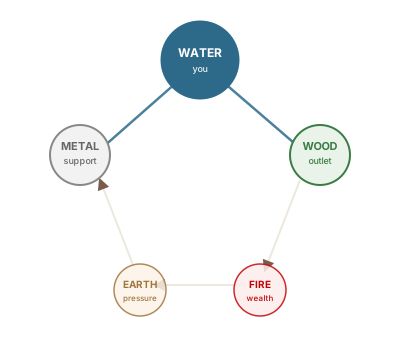
Read it like this: Water is the element that remembers. The memory of the person is stored in Water; the calendar cycles past, and when the branch comes back around, the record lights up. Both charts are reading the same cycle. This is why contact often syncs.
This is also why some returns produce contact and some only produce the feeling. If only your chart is crossing the recurrence, you feel them; they don't feel you. If both are crossing simultaneously — common when the originally shared pillar is a branch returning for both — contact happens. If your chart is crossing and theirs isn't, you'll feel the pull without anything happening, and the feeling will fade within 6–10 weeks.
What's actually happening in your chart
Three patterns generate the return.
One: an annual pillar matching the original month. If you met, spent significant time with, or had a peak moment with the person in a specific month, the annual return of that month activates the record. This is the most common trigger — a seasonal recurrence that brings them up every year, sometimes mildly, sometimes strongly. The intensity depends on what else is active in the chart that year.
Two: a branch clash or combination with the relationship pillar. If the current year's branch clashes with or combines with the branch of the year you were most connected, the pull intensifies dramatically. Clash pulls in the form of conflict or unfinished business. Combination pulls in the form of warmth and curiosity. Check the 12-year cycle — this type of recurrence is usually 6, 12, or 24 years after the original.
Three: a Da Yun transition reactivating a pillar. When your 10-year luck pillar rotates, the incoming pillar can match a pillar that was active when you knew the person. Returns tied to Da Yun shifts are typically larger, more meaningful, and more likely to produce real reconnection rather than just contact. They also arrive more slowly — over months, not weeks.
How this usually plays out
Cyclical returns follow a typical pattern:
- Two to four weeks of escalating presence. Thoughts get more specific, reminders get less random, you find yourself drafting messages mentally. You haven't acted yet — the chart is gathering pressure.
- Contact, if both charts are syncing. Usually happens between weeks 3 and 8 of the feeling. Often initiated by whichever person has the weaker natural restraint. The message is typically casual-seeming but carefully drafted.
- A short, defined conversation — or a reopening. Most returns resolve in a few exchanges and then quiet again. Some resolve by reopening the connection for a new phase. The chart usually signals which type within the first two or three messages.
What to do about it
- Don't chase the feeling. If you reach out to end the anticipation, you'll get contact — but the contact won't answer the question the cycle was raising. Wait. Returns that arrive on their own schedule carry more information than returns you forced.
- Write down what specifically is coming up. Not about them — about you, at the time you knew them. The return is often less about the person and more about a version of you that's being retrieved. Name the version.
- Decide in advance what you'd want from contact. Not the conversation — the outcome. Closure? Friendship? Reopening? Information? If you don't know what you want, whatever the message contains will feel like the answer, and you'll over-commit to it.
- If they reach out, respond once, slowly, and then wait. Don't match their pacing if it's rushed. The chart is reading a long cycle — your response should read the same timescale. Quick return messages often collapse back into the same pattern. Slow ones sometimes produce something new.
The short version: the return is a cyclical recurrence, not a coincidence. Water holds the record and the calendar activates it. Don't chase — wait. Decide in advance what you'd want from contact. Respond slowly if they arrive. Let the cycle read itself out.
Your chart shows which cycles are active, whether the recurrence is mutual, and what kind of return this will be. Run your free reading in under two minutes.
Run my free BaZi reading →