Being seen and being understood are different elements. Most people don't notice because they only ever had one. Fire charts often get the first without the second, and the gap between them is a specific kind of quiet loneliness.
If you're broadly recognized — at work, socially, online — and you still feel fundamentally unmet, you're not being ungrateful. You're running a chart that's stronger on visibility than on depth, and the world is meeting you at the surface level you're offering. The fix isn't to be seen less. It's to offer a different signal.
Quick diagnostic
Does any of this sound like you?
- People describe you in terms that are accurate but shallow, and you don't quite recognize yourself in them.
- You've thought "they like the version of me I'm performing, not the actual one" about more than one relationship.
- You can't remember the last time someone asked you a question that actually landed.
- You're popular, or well-regarded, or in demand — and also privately lonely.
- You've considered stripping your public persona down to find out what happens.
The BaZi lens: this is a Fire problem
In BaZi, being seen is Fire. Being understood is a different circuit — it needs Wood, which in Fire charts is the Resource star: the element that feeds you and also gives you depth, meaning, and the interior life that makes you legible in a deeper way. Fire without Wood is a bright surface with nothing underneath for others to recognize. You can be popular and still unknowable.
This is why Fire charts sometimes feel like celebrities inside their own social circles. Everyone has an impression of you; nobody has actually read you. The gap isn't about the other people being shallow. It's about whether your own Wood — your reading life, your interior curiosity, your slower internal processing — has had any air to breathe lately.
The Five Elements
What Fire needs to stay balanced
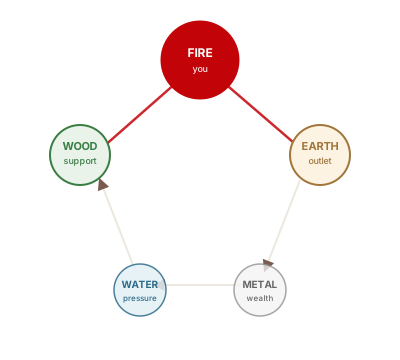
Read it like this: Wood feeds Fire. Water cools Fire. A Fire chart with strong Wood in the mix isn't just bright — it's deep. People don't understand "bright" very well. They understand depth. You can change how people meet you by changing what's underneath.
This pattern intensifies during periods of heavy output without input — when you've been performing, producing, hosting, and visible for months with no real reading, thinking, or solitude. The visibility stays. The depth quietly erodes. People keep up with your updates; they fall out of touch with your actual self.
What's actually happening in your chart
Three patterns produce a "seen but not understood" state.
One: Resource star depleted. If your chart's Wood is naturally thin, or the current pillar is not supporting it, you don't have the interior density that makes you legible at depth. Nothing is wrong with you — you just haven't been in a period that structurally feeds Wood, and the effect shows up externally as people "not getting" you.
Two: you've optimized for the wrong signal. Fire charts are very good at producing the surface features the world rewards — charisma, responsiveness, visible output. Over time, that gets reinforced at the expense of the slower signals (depth, specificity, difficulty) that produce real recognition. The world meets what you offer. You've been offering the bright layer.
Three: the rooms you're in don't metabolize depth. Some rooms are only capable of surface. A Fire chart in a room that rewards performance and punishes complexity will always feel unmet, because the room is returning what it's built to return. This isn't a signal that something's wrong with you; it's a signal that you're in the wrong rooms for the particular thing you're missing.
When this shifts
Three windows tend to close the gap between being seen and being understood:
- Wood months. Tiger, Rabbit, and Dragon — February through April — quietly thicken the interior. Fire charts report feeling more like themselves, less like their persona, during these months. That's because the Resource star is getting fed by the calendar.
- When your 10-year luck pillar introduces Wood or Water. A pillar that restores the interior element you've been missing is often the moment a Fire chart "grows into themselves." Relationships become realer; surface admirers drop away; specific people get closer. The chart didn't change. The depth-feeding did.
- When you install slow inputs. Short-term, the fastest fix is structural: real books, real sleep, fewer screens, a private practice (writing, instrument, language, anything genuinely slow). Within weeks, the signal you put out changes — and so does the signal you attract.
What to do about it
- Produce less for a season. Visibility without depth is a pattern you have to interrupt to change. Less posting, less hosting, less performing — for a defined period, not forever — gives the Wood room to grow. The performance will be better on the other side.
- Feed your Wood privately. Not for an audience. Pick a subject nobody knows you're interested in and give it twenty minutes a day. This is depth construction. It doesn't have to be public, ever. The density it builds is what other people unconsciously start responding to.
- Change which rooms you're in. A Fire chart in a surface-reward environment will always be seen and not understood. If your current rooms only know how to appreciate the outer layer, you need different rooms — smaller, slower, with people who can read deeper signals.
- Stop performing depth; just have it. The temptation when you notice this pattern is to start posting thoughtful-looking content. Don't. Performed depth reads as surface immediately. Real depth is quieter, and when it shows up, the recognition is different.
The short version: you're not imagining it. A Fire chart can be fully visible and still unseen at the level you actually live at. Depth isn't produced; it's grown. Feed your Wood, narrow your rooms, and the people who can meet the actual you will find you.
Your chart shows whether Wood is supporting your Fire — and where the pillars are thickening or thinning your interior life right now. Run your free reading in under two minutes.
Run my free BaZi reading →