Relational pattern repetition isn't a character flaw. It's the most reliable signal a chart produces. When the same shape keeps arriving, it's because something in the chart is magnetized to that shape — and until the magnetization is understood, willpower does almost nothing against it. You can pick differently on paper and still end up in the same room.
The mechanism is Water. Water in BaZi is memory, and memory is not a neutral record — it's a template. Once a relational pattern is stored in Water with enough emotional weight, the chart begins to recognize matches for that pattern in new people, preferentially notice them, and move toward them before the conscious mind has had time to evaluate. Same type, again, is the chart pattern-matching its own imprint.
Quick diagnostic
Does any of this sound like you?
- The last two or three significant relationships ended with the same complaint — yours or theirs or both.
- You've been in a new-relationship situation and noticed a familiar feeling earlier than you wanted to notice it.
- Friends have pointed out the pattern. You've defended against the observation and then privately admitted it.
- You can trace the template back to one specific earlier relationship that had unusual weight.
- You've done the reading — you know the pattern intellectually — and you keep doing it anyway.
The BaZi lens: the Water template
Every person stores their significant relationships as emotional memory, but charts do this differently. A chart with strong Water stores deeper, holds longer, and retrieves more precisely. The upside: you form real bonds, you remember what mattered, you understand people. The downside: the template written by your most emotionally weighted earlier relationships can run for a decade unchallenged.
The template isn't about physical type or superficial preferences. It's about a specific relational dynamic — the exact way attention was given or withheld, the particular shape of distance and closeness, the rhythm of reassurance and withdrawal. The chart matches on dynamic, not demographics. That's why different people end up feeling the same.
The Five Elements
Why the pattern persists
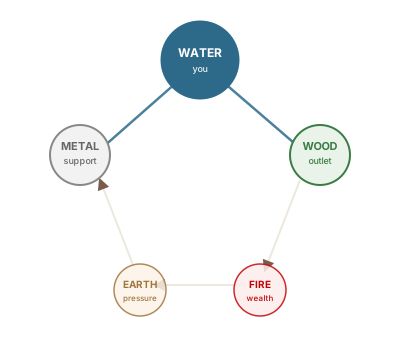
Read it like this: Water holds the imprint. Wood (new experience, new action) drains Water and can revise the template — but only if Wood acts differently, not if Wood repeats. Earth (structure, discipline, conscious boundaries) contains Water and prevents it from defaulting back to the old shape. You need both.
This is why "just knowing" the pattern doesn't break it. Knowing is Metal — discernment. Metal produces Water; it refines the pool but doesn't drain it. To actually change the template, the chart needs Wood (different action) and Earth (sustained containment). Insight alone refills the reservoir of the same pattern with clearer water.
What's actually happening in your chart
Three patterns cause the repetition.
One: an unresolved template from the formative relationship. The first deeply emotional relationship — often not romantic, often parental or early-friendship — wrote a template the chart now searches for matches of. If that relationship had ambivalent, intermittent, or conditional closeness, you'll unconsciously select for that exact quality in later partners, because familiarity feels like fit. It's not fit. It's the imprint.
Two: Water too strong, Earth too weak. When your chart is Water-heavy without enough Earth, you absorb relational patterns but can't contain them. Each new relationship enters the pool and mixes with every previous one. You don't start clean — you start from a reservoir of expectations the new person didn't sign up for. Structurally, this chart needs added Earth: rituals, boundaries, explicit definitions of what the relationship is and isn't.
Three: you're picking during low-clarity phases. Some phases of a chart are better for starting relationships than others. Water-dominant months and dissolution phases tend to produce imprint-matched choices. If several of your relationships started during the same kind of phase, the pattern isn't about you or the other person — it's about the timing. Starting when the chart is in a Wood or Fire phase tends to produce different choices.
When this shifts
Pattern repetition ends under specific conditions:
- A Wood phase where you act differently than the template predicts. The drain only updates the pool if Wood carries something new. Repeating the same pattern during a Wood month just drains old water into old shapes.
- An Earth year or Da Yun. A decade of stronger Earth tends to produce structurally different relationships because the chart finally has containment. Many people's first successful long-term relationship starts inside an Earth Da Yun.
- A rupture significant enough to update the imprint. Usually not recommended as a strategy but worth naming: occasionally a relationship ends in a way that rewrites the template by force. The pattern breaks because the chart can no longer recognize matches for the old shape.
What to do about it
- Name the dynamic, not the type. Write one paragraph describing the exact relational shape you keep recreating — the rhythm of closeness, the specific kind of withdrawal, the quality of reassurance. If you can name the shape precisely, you can notice it earlier in new people.
- Add Earth to your life before adding a person. Routines, boundaries, explicit self-definitions, clear yeses and noes. The chart needs containment infrastructure or the next person will merge into the reservoir like the last one did.
- When you feel the familiar pull early, treat it as data, not attraction. The "instant chemistry" that matches your imprint is usually the pattern recognizing itself. Slow down. Date the person for 90 days before you decide anything. Imprint-matched attractions usually reveal themselves by day 40.
- Start relationships in different phases than you used to. If every major relationship started in late autumn or winter (Water season), try getting to know someone during spring or summer. Same person will feel different — and you'll see them more accurately.
The short version: the repetition is Water's memory imprint matching on dynamic, not demographics. Insight alone doesn't update it — you need new action (Wood) and sustained containment (Earth). Name the dynamic, add structure before adding a person, and treat familiar pulls as signal to slow down.
Your chart shows the imprint, the missing containment, and the phases that change the pattern. Run your free reading in under two minutes.
Run my free BaZi reading →