There's a specific kind of no where the refusal works but the aftermath doesn't. You're not the person who can't set a boundary — you actually can, sometimes remarkably well. What you can't do is let the boundary stay set without a haunting that lasts hours. The no was Metal. The guilt is Fire catching the Metal after the cut.
This is a different mechanical pattern from "can't say no." In a can't-say-no chart, the Metal is blocked before execution. In this chart, the Metal is working fine — the problem is the Fire dynamic that punishes Metal for doing its job. Diagnosing which one you are matters, because the fix is different.
Does any of this sound like you?
- You can say no — cleanly, even — and then you spend the next hour drafting apology texts you don't send.
- You preemptively overexplain your refusals, adding paragraphs of context no one asked for.
- You've said no correctly and then cancelled the no 24 hours later out of guilt.
- When the person accepts your no gracefully, you feel worse, not better.
- You were raised in an environment where "no" was a moral failure, not a logistical response.
The BaZi lens: this is a post-no Fire problem
In Metal charts, the Officer dynamic is Fire. Healthy Officer Fire gives you structure, responsibility, a functioning sense of duty. Excess Officer Fire creates a chart that internally punishes every refusal as if it were a moral breach. You said no; the chart treats it like you broke something. The guilt is the chart's own enforcement, not the other person's reaction.
This is why people-pleasing isn't actually about other people — it's about the internal Fire that makes any refusal feel like you've violated a contract with a much older audience. Current friend. Old rule.
The Five Elements
Why the guilt arrives anyway
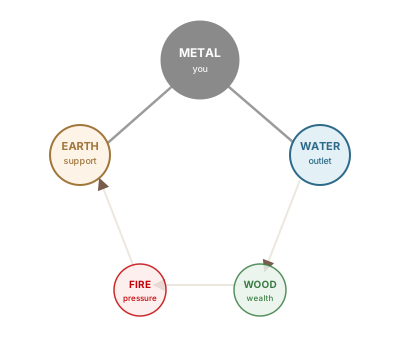
The no doesn't need to be undone. The Fire dynamic needs to be dialed down so the Metal can hold its own execution without having to apologize for it ten minutes later.
What's actually happening in your chart
Three patterns recur in post-no guilt charts.
One: Officer Fire tied to an early audience. The original Fire source wasn't cultural or generic — it was a specific person or pair (usually a parent, a religious figure, a demanding older sibling). Your chart installed them as the permanent judge. Every no is now being evaluated by an audience that often isn't even present and sometimes isn't even alive.
Two: over-calibrated empathy. The chart runs an emotional simulation of the other person's disappointment with such fidelity that the simulation functionally replaces their actual reaction. You respond to your model of their hurt, not their hurt. The guilt is modeling-error, not data.
Three: Fire without Water outlet. Water (wisdom, reflection, processing) is what cools Fire after it fires. Charts that don't have functional Water leave guilt running continuously — the Fire has nowhere to go after it triggers. The guilt therefore never resolves; it just gets reheated on the next no.
When this shifts
Post-no guilt patterns ease in specific windows:
- Water seasons. Pig and Rat months — late autumn and early winter — introduce the Water your chart needs to cool the Officer Fire. Guilt feels lower, reflection feels more useful, and the "should I have said no?" loop runs quieter. Many hard but clean no's settle in these months.
- Water Da Yun rotation. A luck pillar entering Water often produces the famous "I stopped apologizing so much in my thirties" report. The Fire isn't smaller; the Water finally matches it. You'll notice the change as a subtle internal permission.
- Direct audience confrontation. When you explicitly address the original audience — by having the conversation, grieving the relationship, or simply naming the rule out loud — the Fire loses its grip. The chart stops enforcing a contract you never actually signed.
What to do about it
- Name the audience out loud. "The guilt I'm feeling is from [person/group]." Saying it specifically collapses it faster than any reframe. Fire that gets named loses about a third of its power immediately.
- Time-box the guilt. When the post-no spiral starts, give it 20 minutes and move. The chart will try to run for hours; you interrupt the loop. Post-no guilt shrinks fastest when the nervous system learns the no didn't produce catastrophe.
- Stop overexplaining. Every paragraph of justification is Fire looking for absolution. A clean no — one sentence — actually produces less guilt than a five-paragraph no. Counterintuitive, mechanically true.
- Install Water intentionally. Journaling, long walks, talking it through with one friend (not five). Water practice cools the Fire before the next no. Charts with regular Water downstream report a dramatic drop in chronic guilt within a few months.
Your chart shows exactly which Officer Fire is active and when the Water windows cool it. Run your free reading in under two minutes.
Run my free BaZi reading →