A boundary is the most basic Metal function there is. Draw a line. Signal on which side things belong. Enforce the edge. A chart that's running Metal well doesn't really think about boundaries — it just has them, the way a glass has a rim. A chart where Metal is present but underactive sees the rim in theory and keeps watching liquid pour out of the glass.
Most people assume they need to "find the courage" to set a boundary. In BaZi terms, that's rarely the real issue. The issue is that the Metal function has been trained to stand down, and standing down has become the reflex. Until the reflex is retrained, no amount of courage arrives on time.
Does any of this sound like you?
- There's a sentence you've been meaning to say to the same person for more than six months.
- You handle the violation by managing your reaction instead of managing the line.
- You tell your friends "I really need to talk to [person] about [thing]" and then you don't.
- You've been told you're "so chill" by people who don't know how chill you are actually not.
- Every time the situation repeats, your internal response is slightly flatter — and you're worried the flatness means something is dying.
The BaZi lens: this is a conditioned-Metal problem
Most chronic boundary problems aren't about weak Metal — they're about Metal that learned, early, that drawing the line produced worse outcomes than absorbing the cost. The chart is protecting you with what used to work. It will keep protecting you with what used to work until you explicitly reprogram the cost ledger.
What dulls the blade long-term is chronic low-grade Fire pressure — not dramatic conflict, but the constant drip of "they'll be upset," "it'll make things awkward," "it's not worth the fallout." Each drip melts a micro-amount of Metal. After years, the blade is still there and it can't draw a single line.
The Five Elements
Why the blade stays down
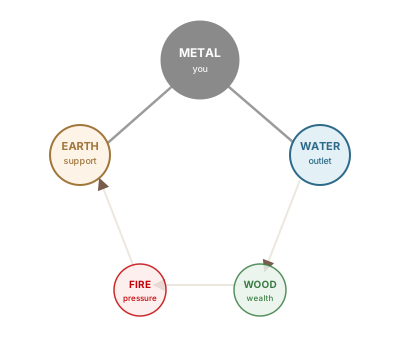
The fix is not to flood the system with willpower. It's to reduce the Fire pressure and rebuild Earth support so Metal has a base to cut from.
What's actually happening in your chart
Three patterns keep recurring in charts where the line won't get drawn.
One: early conditioning around disappointment. Somewhere young, you learned that disappointing someone produced more cost than absorbing a violation. The Metal function dutifully installed "absorb" as the default. That install is still running. Most adults with chronic boundary issues can name the original audience in under 30 seconds if they try.
Two: proximity without role clarity. The violators are close — a partner, a coworker, a family member. Your Metal can't draw a line without a role to cut against. When the role is fuzzy ("we're just... close"), the chart has no edge to enforce. Naming the role explicitly often draws the line before you have to.
Three: the accumulator trap. Each violation is small enough to ignore. You ignore it. The ignored violations compound silently. When you finally try to set the boundary, you're responding to the accumulated mass, not the current event, and the response feels disproportionate — so you back off again. The math of accumulation is why boundaries need to be set small and early, not big and late.
When this shifts
Boundary-stuck charts re-enable their Metal in specific windows:
- Metal months. Monkey and Rooster — roughly August and September — are when the blade is mechanically sharpest. Hard conversations that felt impossible in February tend to happen, almost calmly, in late summer.
- Post-depletion clarity. The point where absorbing costs more than enforcing. Every long-conditioned Metal chart eventually hits this — often in a specific season — and the line finally draws itself. You'll know the month when it arrives because the sentence comes out before you've decided to say it.
- New-context shifts. New job, new city, new relationship, new year. A new context resets the conditioning briefly. Boundaries that were impossible in the old context are often effortless in the first months of the new one. Use the window.
What to do about it
- Draw small, draw early. Don't wait for the big violation. Draw the tiny line on the tiny version. Small lines don't need speeches — they need a short, clear sentence the first time. "Hey, please don't do that." The blade stays sharp when it's used.
- Name the role. Before drawing a line, define the relationship out loud to yourself. "This person is my coworker, not my friend." "This is my parent, not my therapist." Metal cuts against defined edges. Ambiguity defangs the cut.
- Script the sentence. Write the line you've been rehearsing. Read it out loud in your own voice. One sentence. No explanation. Metal doesn't justify. The sentence gets shorter the more you rewrite it, and short sentences are the ones that actually leave your mouth.
- Expect discomfort, not catastrophe. Every chronic boundary avoider overestimates fallout by roughly 5x. Set the line, observe the actual reaction, recalibrate. The lived evidence updates the nervous system faster than any amount of mental rehearsal.
Your chart shows exactly how your Metal is being conditioned and when the windows to re-engage it open. Run your free reading in under two minutes.
Run my free BaZi reading →