Metal charts carry a particular burden: they can see clearly. Not all the time, not infallibly, but often enough and precisely enough that the sentences they could say would change situations. The weight is in the fact that they can see — and therefore the kindness of saying matters, and the failure of saying hurts someone on a delay.
The real tension isn't between clarity and kindness. It's between clarity now (uncomfortable for an hour) and clarity later (damaging for years). Metal charts often think they're being kind when they soften a message. They're usually being kind to themselves, and unkind on a longer timeline to the person they withheld from.
Does any of this sound like you?
- You can see what a friend needs to hear, and you've been circling the conversation for months.
- You've said "I should have told them sooner" at least three times in the last year.
- Your clearer sentences come out softer than you meant them — and the message gets lost in the softening.
- You associate directness with being a bad person.
- The people who've been most helpful in your life were more direct with you than you'd dare to be with others.
The BaZi lens: sharpness is a kindness tool
In BaZi, Metal is compassion through precision. Its core move is to say the true thing in a way that produces change rather than comfort. When Metal is well-formed, direct messages land as care. When Metal is softened by chronic avoidance, even tiny directness feels like a violation. The chart has lost the calibration of how sharp is too sharp — and everything starts feeling too sharp.
The internal experience is: "I don't want to be harsh." The external reality is: you're often less harsh than you think, and the people on the receiving end are often starving for someone who will finally say it. Softness chronically withheld becomes neglect. Clarity is how Metal actually loves people.
The Five Elements
Why the cut is kind
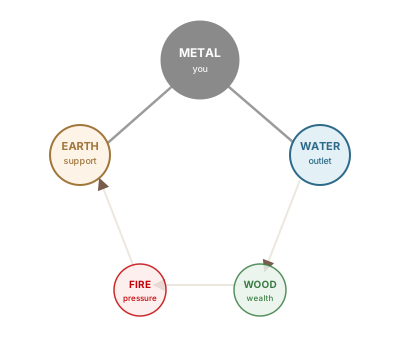
A chart that learns to use its Metal doesn't become cruel. It becomes the person everyone in their life trusts with the hard sentence, because the sentence arrives with both accuracy and care. That's a rare combination and a structural gift of the element.
What's actually happening in your chart
Three patterns recur in Metal charts that can't trust their own clarity.
One: directness conflated with cruelty. Early in life, you encountered directness paired with contempt — a parent, teacher, or early authority who was sharp and mean. The chart bundled sharpness with meanness and has been refusing to use the tool since. The tool isn't the problem. The pairing was.
Two: softening that obscures meaning. You do say the clear thing, technically — but you wrap it in so much preamble and qualification that the listener walks away with the wrong impression. The Metal fired; the signal was buried. This creates a compounding problem where you feel unheard, they feel you didn't say what you said, and neither of you gets the benefit of the clarity.
Three: the false choice between harsh and honest. Many Metal charts believe they have two options: cruel directness or kind vagueness. The third option — precise, warm, clear — goes unexercised. It's also the one the chart was built for. Most "harsh" sentences aren't actually harsh; they just don't leave room for misunderstanding.
When this shifts
Clarity re-enablement tends to arrive in specific windows:
- Metal months. Monkey and Rooster — late summer and early fall — are when the sentence is easiest to say and hardest to misunderstand. The courage is on sale seasonally. Notice what conversations happen in September most years.
- Water-wisdom rotations. Water-heavy Da Yun pillars are when Metal learns the warm, reflective sharpness that lands as care. Many clinicians, editors, mentors, and leaders come into their clarity here. If you're heading into one, this is the decade you stop softening past the meaning.
- After a withholding regret. The moment someone you should have been direct with says "I wish you'd told me sooner." Most Metal charts reorient permanently after one of these. The withholding instinct loses credibility and the clarity instinct regains it.
What to do about it
- Practice precise warm sentences. "I'm worried about X because Y." "I don't think this is working." "I need to say something uncomfortable, and I care about you enough to say it anyway." The structure is always: precise, grounded, warm. Short. No preamble past one sentence.
- Stop apologizing for clarity. "Sorry if this is blunt" trains the listener to hear what follows as an attack. Just say the thing. Metal doesn't need an apology before use.
- Test whether your softening hid the meaning. After any hard conversation, ask: "What did you hear me say?" If their summary differs from your intent, the softening broke the signal. Calibrate down on wrapping, up on precision.
- Accept that the moment is harsh. Ninety seconds of discomfort is the price of durable kindness. Withheld clarity is the currency you pay year after year to avoid that ninety seconds. The math is never close.
Your chart shows how your Metal is calibrated and when clarity is easiest to deliver cleanly. Run your free reading in under two minutes.
Run my free BaZi reading →