Saying no is not a personality trait. It's a function the chart either performs on time or performs late. People who say yes reflexively aren't spineless — they're running charts in which the refusal signal arrives after the yes has already been sent. You can't fix a timing problem with willpower. You fix it by changing the sequence.
In BaZi, the function that draws the line between "mine" and "not mine" is Metal. When Metal is over-generated by too much Earth — loyalty, duty, nurturing, belonging — it becomes a dulled blade. Everything looks like something worth helping with. The yes is automatic because the filter that would catch it never triggers.
Does any of this sound like you?
- You say yes before you've thought about capacity, then rearrange your week to honor it.
- The regret always shows up within minutes, not days.
- You can't remember the last time you said "let me get back to you" and actually used the time.
- You describe yourself as "bad at disappointing people" more than you describe yourself by anything else.
- Other people's urgency becomes your urgency within 60 seconds of contact.
The BaZi lens: this is an over-Earth problem
Earth generates Metal. That's supposed to be supportive. But when Earth dominates — heavy loyalty, strong family duty, a chart packed with Earth branches — Metal becomes over-buffered. Metal in this state doesn't feel sharp; it feels obligated. It can't perform the cut because it's been trained to absorb.
The people with the most-present, most-trusted, most-reliable reputations in their networks are very often Earth-heavy Metal charts. The reputation is earned. It's also the cage.
The Five Elements
Why the no won't fire
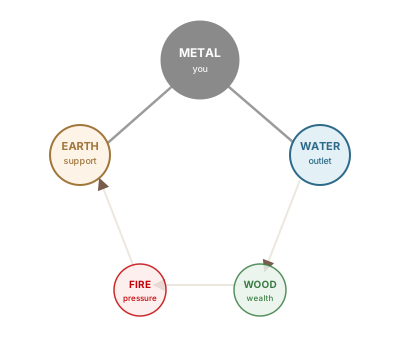
This is the counterintuitive part: you don't need more Metal. You need less Earth pressure on the existing Metal. Most advice about "learning to say no" fails here because it tries to strengthen something that's already overloaded.
What's actually happening in your chart
Three patterns recur in Earth-heavy Metal charts that over-commit.
One: reflex yes as loyalty default. Your chart has been organized around loyalty since early life. Saying yes was how belonging was earned, and the pattern calcified before you could examine it. In your nervous system, "no" and "abandonment" still share a cable. The yes isn't for the person asking — it's for the child who learned to secure belonging by showing up.
Two: no discretion gradient. Healthy Metal runs a gradient — small asks get a quick yes, medium asks get a pause, large asks get a real evaluation. Over-Earth Metal flattens the gradient. Every ask gets the same "of course." The chart has lost the ability to weight requests by size.
Three: the audience problem. Earth-heavy Metal is performing for a specific audience — usually an early-life audience (parents, a religious community, a tight friend group). Current asks are being processed as if that audience is still watching. The no feels impossible because you're trying to say it past a ghost.
When this shifts
Over-Earth patterns rebalance in specific windows:
- Wood months. Tiger and Rabbit months break Earth's compaction. Refusing in March and April feels meaningfully easier than refusing in July. Many people ship their hardest "no"s in early spring without realizing why.
- Water-Metal Da Yun. A luck pillar emphasizing Water or Metal directly loosens the Earth grip. People often describe their thirties or forties as "when I finally started saying no" — that's typically a pillar rotation.
- Distance from the original audience. When the ghost audience literally moves out of your life (a parent passes, a community dissolves, you relocate), the yes reflex suddenly has nothing anchoring it. The transition can feel unmooring and liberating in the same month.
What to do about it
- Install a response delay as default. Your refusal function runs late. Match the timing. Set a rule: no yes on any ask for 24 hours unless someone is bleeding. The yes reflex loses its power when the channel is closed.
- Name the ghost audience. Write down who you are actually saying yes to. Usually two to four names — often not present, sometimes not alive. The current ask is rarely to the current person. Clarity about who you're performing for drops the rate significantly.
- Replace no with a soft decline script. "I can't commit to that this quarter" is more accessible than "no." Over-Earth Metal doesn't need the blade; it needs a gentler tool that still cuts.
- Track the cost. For one month, log every yes and what it displaced. Earth-heavy charts can't feel cost in the abstract — they need it legible. Seeing the ledger usually does more than a year of self-talk.
Your chart shows exactly how much Earth pressure your Metal is carrying and when the calendar offers relief. Run your free reading in under two minutes.
Run my free BaZi reading →