Charts with strong Metal are polarizing by design. Metal produces definition — clean edges, clear values, unambiguous direction. Anyone whose chart favors diffuseness, ambiguity, or constant agreeability will bounce off strong Metal the way water bounces off a sharp edge. That bounce isn't personal. It's the physics of two different shapes.
The pain isn't that some people don't like you. The pain is that you've been taught universal liking is the metric of a good person. It's not. It's the metric of someone whose edges have been sanded off until everyone can hold them comfortably. That's not health. That's erosion.
Does any of this sound like you?
- You've been told, by multiple people over the years, that you can be "intense" or "intimidating" without meaning to be.
- There's someone in your life whose dislike of you is palpable and reasonless, and you've spent real energy trying to earn their approval.
- You can name the specific friend groups or workplaces where you'd never quite fit — and you still tried to fit.
- Your clearest, most confident moments are the ones that seem to create the most quiet friction.
- You've softened yourself to fit a room and come out of it feeling emptier, not smaller.
The BaZi lens: this is structural polarity
Every element attracts some and repels others. Wood people are naturally drawn to other growth-oriented charts. Fire people cluster with warmth and visibility. Earth people bond over loyalty. Water people over depth. Metal — clarity, structure, clean edges — is the element most consistently misread as cold, judgmental, or "too much," particularly by charts whose comfort zone is ambiguity.
The misreading is not your problem to solve. It's the natural consequence of being a definite shape in a world that often rewards blur. A Metal chart that tries to be universally liked has to round off its own corners, and rounded Metal is not stronger Metal — it's less of itself.
The Five Elements
Why the edge creates friction
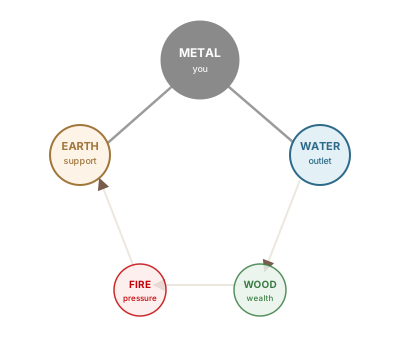
The goal isn't to be liked universally. The goal is to be liked correctly — by the people whose charts complement yours and who benefit from your clarity. That population is finite. It's also entirely sufficient.
What's actually happening in your chart
Three patterns recur in Metal charts struggling with non-universal likability.
One: soft-Metal overcompensation. Early in life, you realized your natural clarity produced discomfort in others. You started rounding off — agreeing more, stating less, hedging everything. This creates a chart that's softer on the outside and more frustrated on the inside. The dislike decreased; so did the aliveness.
Two: mis-targeting your audience. You're trying to be liked by people whose charts structurally can't receive you. A Water-diffuse chart will always find strong Metal slightly abrasive. A Fire-dramatic chart will find your calm unimpressive. These aren't problems to solve — they're signals about which rooms are worth your presence.
Three: confusing integrity with isolation. Some Metal charts respond to misreadings by going fully solitary — "if you don't like me I'll just be alone." That's Metal with no Earth grounding it in relationship. Health isn't universal approval; it's a small, accurate circle of people who read you correctly. Build the circle instead of minimizing the radius.
When this shifts
Polarity acceptance arrives in predictable moments:
- After the first unapologetic loss. The first time you stay yourself and a person walks away — and you observe that your life is actually better a few months later — the whole calculus changes. You stop auditioning for approval you don't need. This moment usually comes in your late twenties or early thirties.
- During Water-year reflection. Water-heavy years produce the clarity that "the people I actually trust are this specific handful." Once the small circle is legible, the disapproval of the large non-circle loses its weight.
- When Metal months amplify the signal. Late summer and early fall are when your edges feel most natural and most yours. Notice who comes closer and who pulls back during these months — it's the clearest sorting the calendar does for you.
What to do about it
- Stop auditioning for the wrong rooms. If you've tried for years to be liked by a specific person or group and haven't been, the chart-level answer is: you won't be. Redirect the effort toward people who receive clarity rather than react to it.
- Notice who reads you correctly. A Metal-correct reader will find you reliable, easy to plan with, and safe. If someone reads you that way, they are your audience. Invest there. Accuracy is a relationship resource.
- Don't edit your edges to shrink friction. Every edge you sand off is a piece of your chart you're voting against. Friction is the price of being shaped. Pay it and keep your shape.
- Let misreadings land. Someone describes you inaccurately — "cold," "intense," "judgmental." You don't have to argue with it. Misreadings are data about the reader. Most of the time, no rebuttal is necessary.
Your chart shows exactly how sharp your edges run and which rooms will receive you correctly. Run your free reading in under two minutes.
Run my free BaZi reading →