Being passed over isn't usually a performance problem. By the time you've been passed over twice in the same year, the people above you almost certainly know you're competent. The issue is that competence isn't what gets promoted — legibility does. And Metal charts are, by nature, the least legible element in the entire wheel.
Metal is clean, precise, structured. It's also quiet. It doesn't perform. It doesn't narrate. It does the thing, expects the thing to speak for itself, and watches someone louder get credit for a version of the thing with more emotional punctuation. The pattern isn't cosmic injustice. It's a structural mismatch between what your chart produces and what the room rewards.
Does any of this sound like you?
- You've been told, more than once, that you "fly under the radar" or "should speak up more."
- When credit gets distributed, you get it last, quietly, and often in private.
- Someone whose output you respect less has been promoted past you in the last 12 months.
- You assume the quality of your work will be noticed, and it isn't.
- The idea of self-promotion makes you feel slightly sick.
The BaZi lens: this is a Metal-Officer problem
Recognition, authority, and promotion fall under what BaZi calls the Officer dynamic — for Metal charts, that's the Fire element. Fire is what forges Metal into a named, visible, titled form. A Metal chart with weak Fire has a real structure but no sharp outline. The shape is there; the edge isn't lit.
Fire isn't charisma. It's visibility. It's the willingness to be in the room saying the thing, taking the call, being the named face on a result. Metal without Fire produces flawless work that belongs to "the team." The people who advance aren't better — they just lit their own edge.
The Five Elements
Why the structure isn't lighting up
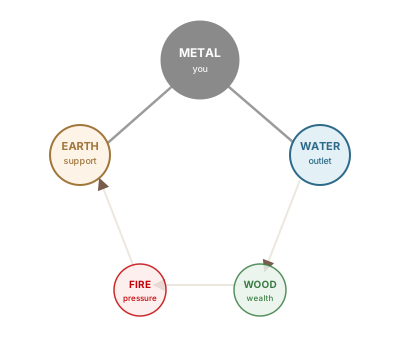
You don't need to become a different person. You need to let the Fire in the chart do its job, which is to make your already-existing structure legible in the language the room uses.
What's actually happening in your chart
Three patterns recur in Metal charts that keep getting passed over.
One: zero Fire in the current pillar. If your current luck pillar doesn't carry Fire and your chart never did, the Officer dynamic is structurally dormant. Work gets done, nothing converts it into title. This phase has an end date — often a specific Da Yun rotation — and the promotion will arrive mechanically on that timeline.
Two: Fire that's only private. Some Metal charts carry Fire in the hour pillar or day branch, meaning the visibility happens in one-on-ones, not in groups. You get singled out for excellent work in private messages and forgotten in public rooms. The Officer is there — it's just not broadcasting.
Three: Metal that's ashamed of being seen. This is the most common and the most frustrating. Fire is present in the chart, but cultural or familial training has taught you that visibility is vulgar. Every time you're near the spotlight you step out of it, then resent the person who didn't. Your chart could perform; you've trained it not to.
When this shifts
Officer-dormant phases have predictable endings:
- Fire seasons. Snake, Horse, and Goat months — roughly May through July — activate Officer energy. Most Metal charts report that their visible moments (big presentations, recognition, title conversations) cluster here. If your reviews always happen in June, that's the pattern.
- Fire Da Yun rotation. A luck pillar entering Fire is the single biggest career legibility shift available to a Metal chart. People who "suddenly started getting promoted in their late thirties" usually just crossed into a Fire pillar. If yours is coming, the next decade is categorically different.
- External Fire events. A new boss who actually watches, a public-facing project, a forced pitch moment. When life drops Fire into your environment, your existing Metal converts to title much faster than internal readiness can explain.
What to do about it
- Make one output visible per week. Pick the week's best piece of work and ensure one senior person sees it in a medium that leaves a trace. Email, not hallway. Document, not verbal. Metal that leaves artifacts becomes Metal that gets promoted.
- Name your outcomes in public. "I led the X project" is a complete sentence. Most passed-over Metal charts won't say it. Say it. Once per quarter to leadership. The room is not assuming it on your behalf.
- Stop waiting for cycle-based recognition. Annual reviews are where Metal finds out promotions already happened elsewhere. Ask for a feedback conversation at an odd time — mid-cycle, outside the rhythm — and state what you want from the next six months. Mid-cycle asks convert more than end-cycle hopes.
- If the room doesn't have Fire, move rooms. Some environments will never read Metal correctly. If you've been doing this for three years in the same place with the same result, the chart isn't the problem — the room is wrong for it. A room that reads structure is a legitimate career goal, not a compromise.
Your chart shows where your Officer dynamic is and when the next Fire window arrives. Run your free reading in under two minutes.
Run my free BaZi reading →