Chronic performance is a feature of Fire charts under pressure, not a personality defect. And it's reversible once you see the mechanics.
If you can't seem to find the "off" switch — if relaxing feels like a performance of relaxing, if you've started wondering who you'd even be without the presentation — you're running a Fire chart whose cooling system has gone underground. Getting it back isn't about trying harder to be authentic. It's about structural changes to what your chart actually has access to in a day.
Quick diagnostic
Does any of this sound like you?
- Alone, you catch yourself still "on" — monologuing internally, posture adjusted, expression curated.
- You're not sure when you last did something that wasn't partially for an audience, even an imaginary one.
- You've felt a flicker of panic at the idea of being bored in silence with no phone.
- People describe you as "high-energy" or "always on" and you've stopped being sure whether that's a compliment.
- You suspect that if you actually stopped performing, you wouldn't recognize what's left.
The BaZi lens: this is a Fire problem
In BaZi, Fire under sustained Water pressure — that is, under persistent external control, high stakes, authority figures, or an environment that punishes mistakes — responds by performing harder. This is counterintuitive but consistent: Fire threatened by Water doesn't dim, it brightens. The logic is survival-level. If you can't be cooled, be bright enough that nobody cools you.
Over time, the performance becomes the default setting. Your chart forgets there's another mode. What looks like ambition or charisma is often a Fire-under-Water pattern running on autopilot — and what feels like "I don't know who I am when I'm not performing" is accurate. You've been in the pattern long enough that the quieter self hasn't had practice being itself.
The Five Elements
What Fire needs to stay balanced
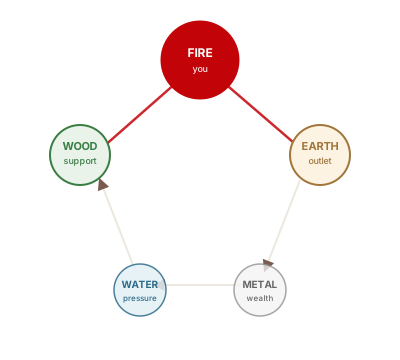
Read it like this: Water normally cools Fire gently. But too much Water or aggressive Water flips the relationship — Fire responds by performing to survive. The same element that should be your recovery becomes the pressure. Fixing this requires restoring Water to its gentle form: solitude, not surveillance.
This pattern is worst during Officer Star-heavy periods — Water months and years for a Fire chart, combined with pillars that concentrate authority, judgment, or high-consequence environments. If your life has been unusually high-stakes for a long time, the performance mode is probably the adaptation, not the personality.
What's actually happening in your chart
Three patterns drive chronic performance.
One: Officer Star over-activated. If your chart's Officer element (Water for Fire) is strong, or the current pillar is loading it, you're living under internal pressure that reads as "I must be good, alert, competent, correct." This produces excellent performance and chronic inability to relax. The same structure that makes you high-functioning is what won't let you off the stage.
Two: no private Wood source. Wood is your interior life — private interests, slow curiosity, self-feeding input that has no audience. A Fire chart that has no private Wood has no interior to return to when the lights go off. The performance persists because the alternative isn't there yet.
Three: real solitude has been out-competed. Modern life makes it structurally hard for Fire charts to be alone without being observed (by a screen, a notification, a potential audience). Solitude-with-surveillance isn't solitude; your chart reads it as a lower-intensity stage. If every "alone" hour still has an audience channel open, the performance never pauses.
When this shifts
Three windows tend to let Fire stop performing:
- Wood months. Tiger, Rabbit, and Dragon — February through April — quietly restore interior material. Fire charts often notice that they need less audience during these months. That's not a coincidence; that's the calendar feeding the missing piece.
- When your 10-year luck pillar drops out of Water or brings Wood. A Da Yun rotation that reduces Officer-star pressure or adds Resource-star feeding is usually where chronic performers rediscover a private self. This is often a multi-year process, not a weekend retreat.
- When you install true solitude. Short-term, the fastest lever is structural: hours a week with no screen, no audience, no potential-observer. Fire charts that install this start being able to hear their own voice again within weeks.
What to do about it
- Audit where the real pressure lives. Performance mode is almost always a response to specific pressure — a workplace, a family role, a public profile. Name the exact source. You can't loosen what you haven't located.
- Install surveillance-free hours. Not "off the clock" — off the signal. No phone, no draft emails, no imagined audience. Start with 60 minutes a week if that's all you can stand. The chart will object for the first few sessions. Keep going.
- Build Wood in private. Pick a slow, private, un-postable interest. Practice it when nobody can see. Fire charts recovering from chronic performance almost always find their real self again through something that was never for an audience.
- Don't perform the recovery. The instinct is to post about healing, to narrate the shift, to tell people about the work. That's still performance. Let it be quiet. The proof that the pattern broke is that you stopped broadcasting it.
The short version: chronic performance isn't who you are — it's a Fire-under-Water adaptation that forgot it was temporary. The off switch exists. It's behind real solitude, private Wood, and less audience than you think you need. The quieter self is still in there, waiting for air.
Your chart shows exactly where your Officer-star pressure is coming from, whether your Resource star is feeding you, and what a sustainable off-stage life actually looks like for your specific element mix. Run your free reading in under two minutes.
Run my free BaZi reading →