People with Fire-leaning charts have a complicated relationship with attention because their element literally depends on it to burn, and is also consumed by it.
If you've noticed that visibility — at work, online, in a room — gives you a hit and a hangover in the same motion, that's not modern self-doubt. It's an ancient pattern dressed in modern clothes. Your chart needs attention the way a candle needs oxygen, and just like a candle, too much of it blows the flame out. Learning the metabolism is the work.
Quick diagnostic
Does any of this sound like you?
- You've posted something, watched it do well, and felt worse by the end of the day.
- Praise from strangers lands harder than praise from people who actually know you.
- You're privately disappointed when a post underperforms and privately embarrassed when it overperforms.
- You've considered going private, quitting a platform, or disappearing for a month specifically to stop being seen.
- You know you'd miss it if you did.
The BaZi lens: this is a Fire problem
In BaZi, visibility, reputation, and public attention are Fire. A Fire-leaning chart isn't "attention-seeking" in the shallow sense — it's that your element's full expression involves being witnessed. A candle in the dark works. A candle behind glass, alone, is technically still a candle, but it's not doing what Fire was made for.
The contradiction shows up because Fire charts are also very aware of being watched. Attention isn't neutral data for you — it's energetic input. A hundred strangers seeing you carries weight, whether the comments are kind or cruel. That's why public-facing people with Fire charts report feeling both lit up and leaky after visibility days. Both readings are accurate.
The Five Elements
What Fire needs to stay balanced
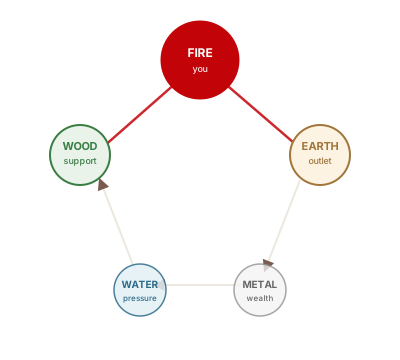
Read it like this: Wood feeds Fire. Fire makes Earth (the tangible body of work your visibility converts into). Water cools Fire (so the visibility doesn't burn you out). Attention without Earth to convert it, or Water to recover from it, is exactly the "good and terrible" loop.
This pattern is sharper during public-facing months, launches, or chart periods where Fire is already activated. If you've been running a Fire peak and posting more, the hit-hangover cycle intensifies because you're metabolizing higher volume.
What's actually happening in your chart
Three patterns make visibility feel contradictory.
One: Fire without Earth conversion. Attention that doesn't convert into something tangible — a conversation, a client, a body of work, actual income — stays airborne. It feels like it should matter and can't land. If you're getting seen but not monetizing, meeting, or building from it, your chart is registering the visibility without the output, and that imbalance reads as emptiness.
Two: Water too weak for the volume. Even a sustainable visibility practice requires real recovery. Fire charts who go public — especially online — and don't double their Water (privacy, sleep, unseen hours) inevitably hit the hangover. The bigger the reach, the more Water you need structurally, not just when you feel like it.
Three: the attention is the wrong shape. Fire charts are sensitive to the quality of attention, not just the quantity. A thousand views from strangers doesn't feed Fire the same way fifty views from the exact right people does. If you're loud but not being seen clearly, the cycle goes bad fast. Specific, accurate witnessing is what actually fuels Fire. Scale without accuracy burns without warmth.
When this shifts
Three windows tend to rebalance Fire-visibility loops:
- Water months. Pig, Rat, Ox — November through January — naturally increase your tolerance for being seen without paying an immediate price. If you go quiet in summer and reappear in winter, that's actually the optimal rhythm for a Fire chart; don't fight it.
- When your 10-year pillar adds Water. A Da Yun rotation that introduces cooling allows you to scale visibility without the same hangover. People often report that they "finally got comfortable being seen" at a specific point in life — it's almost always a pillar shift, not a personality fix.
- Narrowing the audience. Short-term, the fastest repair is cutting the width of the attention to widen its depth — fewer platforms, better audience, clearer niche. Fire responds to being seen correctly more than to being seen widely.
What to do about it
- Build Earth conversion. Visibility should produce something — a list, a client, a book, a meeting. If your attention is all inflow and no output conversion, the cycle will always feel hollow. Add the container before adding more reach.
- Install unseen hours. Time when nobody is watching you isn't a pause from the work — it's part of the work for a Fire chart. Non-negotiable private hours rebuild what public hours drain.
- Don't trust your feelings on post-performance days. Fire charts are unreliable narrators after a visibility spike — everything feels either bigger or smaller than it is. Do not make decisions about your career, your content, or your relationship with the public on a high-attention day.
- Stop performing for audiences who don't feed you. A Fire chart performing for the wrong room burns out twice as fast. Audit who actually feeds you when they see you, and quietly narrow toward them.
The short version: attention is food and threat to Fire charts because the element literally needs to be seen to function, and pays a tax for the experience. The answer isn't to stop being visible. It's to build the output and recovery system a Fire-visibility life actually requires.
Your chart shows how Fire behaves in public — where your visibility sweet spot is, how much output your system can sustain, and which months work with your element vs. against it. Run your free reading in under two minutes.
Run my free BaZi reading →