Running hot isn't a mood. It's a measurable elemental state — and most people don't know how to handle it because nobody ever told them it was real.
If you've noticed that you've been sharper, louder, faster, more charismatic, and slightly less sleep-dependent than usual — and you haven't changed anything about your life to cause it — your chart is in a Fire peak. The energy is real. The risk is real too. Knowing which is which lets you ride the good parts without paying for it for a month afterward.
Quick diagnostic
Does any of this sound like you?
- You're more expressive, more opinionated, and more willing to push than you were a month ago.
- Strangers are responding to you differently — people making eye contact, holding doors, engaging more.
- You've been sleeping less and feeling oddly fine about it.
- Small decisions feel urgent — what to say, what to wear, who to reach out to — even when there's no real deadline.
- Part of you suspects this is temporary and you're vaguely bracing for the drop.
The BaZi lens: this is a Fire problem
In BaZi, peaks like this are usually three things stacking at once: a naturally Fire-leaning chart, a current year or month that carries Fire, and enough Wood (input, stimulation, ideas) to keep the fire loud. When those three align, you don't become a different person — you become a peak version of yourself for a limited run.
The up-side is genuine: conversation flows, work moves, you're braver in meetings, people respond to your presence. The down-side is just as structural: the chart can't sustain this indefinitely. Without Water (cooling, sleep, solitude, discipline), the peak burns through its Wood source and crashes into a recovery week that tends to feel like depression if you didn't plan for it.
The Five Elements
What Fire needs to stay balanced
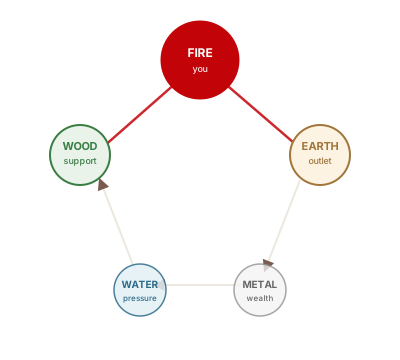
Read it like this: Wood feeds Fire. Fire makes Earth (tangible output). Water cools Fire (sustainability). A Fire peak without Water is a sprint; a Fire peak with Water is a season.
Fire peaks are most common in Snake, Horse, and Goat months — May through July — and around your own Day Master's element showing up in the year pillar. If you're reading this and it's summer, or it's a year carrying your own element, that's why the dial feels cranked up.
What's actually happening in your chart
Three patterns drive "running hot" states.
One: Fire Day Master in a Fire year. If your chart is Fire and the current year pillar contains Fire — especially a Yang Fire year like 2026 — your element is being doubly reinforced. The baseline you're comparing today to isn't neutral; it's your usual lower-Fire state. You're not overreacting to life. You're just more present in it than usual.
Two: Wood-heavy input phase. If you've recently started learning something new, met interesting people, begun a project you actually believe in, or ended a stagnant chapter, your Wood supply just jumped. Wood is Fire's fuel. The burn you're feeling is that source translating into output.
Three: Water is absent or suppressed. The less Water you have in the current picture — limited solitude, thin sleep, constant input — the more the fire burns without restraint. Other people in this same peak might feel controlled intensity; you feel maxed out because you have nothing cooling it. This is where the crash comes from.
When this shifts
Fire peaks don't last forever. Three windows reliably change the tempo:
- Water months. Pig, Rat, and Ox — November through January — drop ambient Fire. The peak you're in now will not feel the same then. If there's something you want to do from this state (ship the thing, send the message, make the move), the window is finite.
- When your 10-year luck pillar rotates out of Fire or Wood. Da Yun shifts every ten years. If the current pillar is Fire- or Wood-leaning, the next rotation often introduces a structural cooling that will make you wish you'd used this era more fully.
- Sleep debt catching up. Short-run, the peak ends when the body decides it's done — usually within 3–6 weeks if not managed. You feel it first as mid-afternoon crashes, then as irritability, then as a full stop.
What to do about it
- Use the peak, don't just feel it. Ship the thing you've been sitting on. Send the message. Have the conversation. Fire peaks are unusually good at first moves — asks, launches, public declarations — and they pass.
- Install Water preemptively. Pick one non-negotiable cooling practice — a daily silent walk, a no-phone morning, an actual bedtime. This is what turns a three-week burn into a three-month season.
- Don't confuse the peak with permanent change. You are not going to be this sharp every week of the year. Don't make commitments that require this level of output continuously. Your future self will be back at normal baseline, and will be handed the bill.
- Watch the recovery window. After a real Fire peak, expect a 5–10 day recovery. Plan for it. Don't schedule anything emotionally expensive in that stretch. Protecting the recovery protects the peak's work from being erased by the crash.
The short version: running hot is real, usable, and temporary. A Fire peak is a genuine productivity window — ship things, make moves — and the people who get the most from them are the ones who install Water on purpose and plan the recovery before they need it.
Your chart shows whether you're actually in a Fire peak — and how your specific pillars are driving it, which months extend it, and when the rotation shifts. Run your free reading in under two minutes.
Run my free BaZi reading →