Earning and keeping are different functions. People who conflate them end up thinking they have a money problem when they actually have a retention problem. The math of an overworked, under-saved professional is rarely about income. It's about the shape of the container — and your container is open on the bottom.
In BaZi, the element responsible for closing wealth into a held form is Metal. When Metal is weak and Water (the outflow element for Metal) is loud, your chart's default is to process wealth, not retain it. You're effective. You're productive. You just happen to be running a through-flow system where the intake and the outflow are almost perfectly matched.
Does any of this sound like you?
- Your income has tripled in the last five years and your savings rate hasn't moved.
- Every large deposit seems to attract an equivalent expense within two weeks.
- You've thought at least once "I make too much to be this broke."
- Money that sits uninvested in your account feels restless — you almost want to move it.
- Friends assume you're wealthy based on your income; only you know the net balance.
The BaZi lens: this is a Metal-Water problem
Every Metal chart produces Water. That's normal. The question is whether the Metal is strong enough to meter the flow, or whether Water drains as fast as wealth enters. When Metal is thin and Water is heavy, your system runs at capacity — every incoming dollar is routed to an outgoing dollar, leaving a net of near-zero regardless of how big the numbers get.
This is why some people feel poor at $80k and other people feel the same at $280k. Income scaled. The retention function didn't.
The Five Elements
Why the money won't stop at you
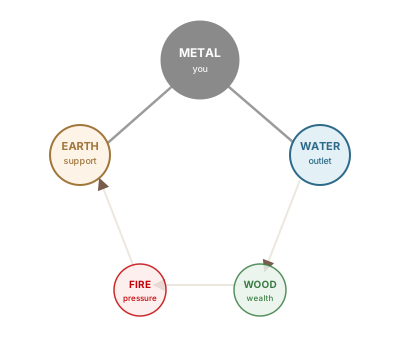
Most through-flow charts don't feel broken to the person living inside them. They feel busy. They feel productive. They feel like they're always just about to get ahead. The ahead never arrives because the shape doesn't allow it.
What's actually happening in your chart
Three patterns dominate in charts where money enters and leaves on the same day.
One: Water excess downstream of Metal. Your chart has Water in the hour or year pillar and thin Metal in between. Whatever Metal earns, Water routes away. In life this shows up as generosity, obligations, recurring commitments, or a lifestyle that has slowly absorbed every raise you've ever received. The Water isn't bad — it's just larger than the Metal feeding it.
Two: no resource anchor. Resource (Earth, for Metal charts) is what stabilizes the day master so Metal isn't drained. Without Earth in your pillars or luck, your Metal is earning and spending in the same breath. You feel tired because the chart is running its containment function on zero sleep.
Three: wealth that arrives through Fire. Some charts earn most of their income through high-pressure, high-visibility Fire work — commissions, performance bonuses, urgent engagements. Fire-earned wealth is harder to retain because the same Fire that generates it is the Fire that melts the Metal needed to hold it. The job itself is mechanically undoing your retention.
When this shifts
Through-flow charts don't heal on their own, but retention windows exist:
- Earth seasons. Dragon, Goat, Dog, and Ox months reinforce your Metal from underneath. This is when budget rebuilds, debt consolidation, and long-overdue savings automation tend to stick. Notice the months you successfully set something up — they usually cluster here.
- Earth Da Yun pillars. A luck pillar anchored in Earth dramatically reshapes retention for ten years. Many people who "finally got it together financially in their late thirties" are reporting the arrival of an Earth pillar. If you're approaching one, the next decade is structurally different.
- Water-heavy years (counterintuitively). When Water is flooding the calendar, you actually notice the leak most clearly — bills, obligations, and expenses multiply visibly. This is the best time to redesign the system, because the pain is legible.
What to do about it
- Route, don't resolve. The Metal function can't retain money it's been asked to decide on. Set the routing once (fixed percentages into untouchable accounts the day the deposit clears), then let your Metal deal only with the remainder. What never enters the operating account can't leave it.
- Reduce Water downstream. Every recurring commitment is Water. Audit the subscriptions, memberships, obligations, and "standing" expenses. Cutting two mid-sized recurring drains usually does more than cutting twenty small discretionary ones.
- Build one Earth asset per year. Earth assets hold value in a form that resists flow — owned equity, a retirement account, a paid-down debt balance. One per year, relentlessly, for a decade. Earth compounds silently while Metal keeps earning.
- Stop measuring yourself by income. Through-flow charts live by income because retention isn't legible to them. Switch the personal scoreboard to net worth growth per year. Same effort, different axis — and the axis is the one that actually moves.
Your chart shows where your retention function is weakest and which years shift you into Earth-backed stability. Run your free reading in under two minutes.
Run my free BaZi reading →