Most office friction isn't about competence or character. It's two charts that happen to sit inside the same building and metabolize pressure in opposite directions.
If there's one coworker who occupies more of your mental bandwidth than their role justifies — and the rest of the team genuinely doesn't understand why you find them so grating — you're running a specific kind of elemental friction. It won't go away through feedback or professionalism. It will go away when you see the mechanics of it and stop spending attention on it.
Quick diagnostic
Does any of this sound like you?
- Their name showing up in your inbox makes your shoulders tense before you've read anything.
- Other people describe them as "fine" or "just how they are" and you think those people are crazy.
- You've mentally drafted a retort to something they said days ago that they probably meant nothing by.
- You're a little afraid of how much real estate this person takes up in your head.
- You've considered changing jobs partly because of them, and you're pretty sure that's an overreaction but can't stop thinking it.
The BaZi lens: this is a Fire problem
In BaZi, work is a structured environment — which means it runs on Metal energy. Rules, processes, titles, deliverables, calendars. Metal isn't bad. Most jobs couldn't function without it. But a Fire-heavy chart sitting inside a Metal environment is already running friction by default. Add one specific Metal-heavy coworker — someone who embodies the rules, the correctness, the "well, actually" — and your element is meeting its structural opposite in human form every day.
Fire melts Metal. Which means your presence, at full heat, threatens their operating system — the thing they feel most competent at. And Metal constrains Fire, which means their presence, at their normal baseline, constrains yours. Neither of you is doing anything wrong. You are running incompatible defaults, and the office has no vocabulary for that.
The Five Elements
What Fire needs to stay balanced
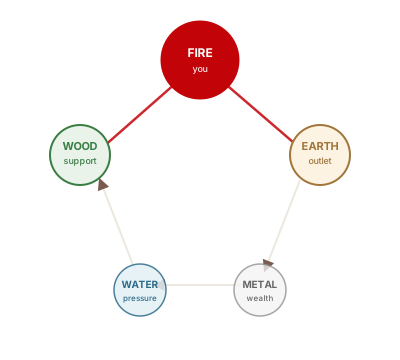
Read it like this: Wood feeds Fire. Fire melts Metal (that's your wealth cycle — and your friction cycle). Water cools Fire. The coworker who gets under your skin is almost always a Metal chart whose baseline behavior looks controlled to them and dismissive to you.
This pattern spikes during Metal months — Monkey, Rooster, and Dog, roughly August through October — and during any quarter when the company is in process-heavy mode (planning, compliance, restructuring). If this coworker suddenly feels unbearable, check the calendar before blaming them.
What's actually happening in your chart
Three patterns show up again and again in Fire charts who can't shake one particular person at work.
One: Fire-Metal clash with no buffer. Without Earth in between (shared rituals, clear working agreements, a manager who actually mediates), the Fire and Metal in your working relationship have nowhere to settle. Every interaction is a direct collision. Earth in the form of shared structure is the thing that usually absorbs this, and it's missing.
Two: you're projecting your own Metal deficit. If your chart has weak Metal — you're allergic to structure, deadlines, process — the coworker who embodies those things is showing you what your chart doesn't want to admit it needs. The heat isn't about them. It's about the thing they represent that your chart keeps avoiding.
Three: your Fire output has no cleaner target. When Fire doesn't have a meaningful creative or expressive channel at work, it finds a person to discharge into. If this coworker is absorbing a disproportionate amount of your mental energy, the underlying question is whether your actual work is feeding your Fire right now. Usually the answer is no.
When this shifts
Three windows tend to change the intensity of a coworker friction:
- Water months. Pig, Rat, and Ox months drop the nervous-system baseline for Fire charts. The same person you wanted to escape in September is a background character by January. That's chart weather, not personal growth.
- When your 10-year luck pillar moves out of Metal. If you're in a Metal-heavy Da Yun, everyone at work who embodies structure is hitting you harder than they used to. The pillar rotation will quietly defuse this — often without you noticing at first.
- When your work actually starts feeding your Fire. A new project, a public-facing role, creative ownership — anything that gives your heat a clean channel — almost always makes the coworker recede. Fire that has somewhere to go doesn't need a person to grind against.
What to do about it
- Stop scoring the relationship. You're not going to win a Fire-versus-Metal argument inside an institution that runs on Metal. The structure will back them. Lower the stakes in your head — it's not a personal referendum, it's two defaults meeting.
- Reduce surface area, not contact. You don't need to avoid them. You need fewer interaction points: async over sync, written over spoken, meetings with agendas over chat threads. Metal respects structure — give them structure and the heat drops.
- Give your Fire a real channel at work. If the job isn't currently asking anything of your chart's actual strengths (expression, pace, visible ownership), the coworker friction will reappear no matter how many times you "move on." Put your Fire somewhere real and it stops needing this person.
- Respect the lesson, not the teacher. Metal charts often carry exactly what Fire charts need and refuse — discipline, patience, structured output. You don't have to like them. You can still notice what they do that your chart doesn't, and borrow it.
The short version: the coworker isn't uniquely awful. They're your element's structural opposite, metabolizing the same workday in the opposite direction. Lower the surface area, feed your Fire elsewhere, and you'll find they're just a person again.
Your chart reveals which elements you clash with predictably and which ones you work with easily — at work, in teams, in leadership. Run your free reading in under two minutes.
Run my free BaZi reading →