There are two kinds of quit, and they don't respond to the same advice.
The first kind is the timing quit — you've outgrown the container, a new pillar is rotating in, and the exit is already being set up by the chart. These quits tend to land on their feet. You leave and within months something better lands. The second kind is the reaction quit — you're exhausted, a Metal pillar is grinding on you, and leaving feels like relief. Reaction quits often land badly. You exit the job and realize the weather didn't change; the problem followed you. Telling the two apart is the single most valuable thing BaZi can do for a person in your position.
Quick diagnostic
Which kind of quit is this?
- You feel urgent — like it has to be today, this week, right now.
- You can't articulate what you're moving toward, only what you're moving away from.
- You've had this exact "I'm quitting tomorrow" feeling before. It passed. Now it's back.
- When you imagine quitting, you feel lighter for 20 minutes and then afraid.
- The main appeal of quitting is not having to keep doing this — rather than becoming something new.
The BaZi lens: the difference between pruning and uprooting
Wood charts have two ways to leave. Pruning is when you cut off a branch that's no longer serving the tree. The tree survives. You come back stronger. Uprooting is when you pull the whole tree out — quit the industry, leave the city, walk away from the identity. Uprooting is survivable, but only inside a specific timing window. Outside that window, the tree can die.
Most people thinking about quitting actually need a prune. They want to pull out one branch — the specific role, the specific boss, the specific team — not the whole life. When the chart supports pruning but the person attempts uprooting, the result is months of drift, regret, and restart. When the chart supports uprooting and the person attempts pruning, nothing moves and the pressure keeps building.
The Five Elements
Metal is the quitting element
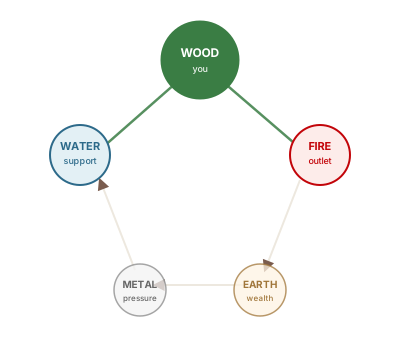
Read it like this: quitting is a Metal action. If your chart or current pillar is Metal-heavy, you'll want to leave often — sometimes more than is wise. If you're light on Metal, the quit you need won't come on its own.
What's actually happening in your chart
One: you're late in a Metal pillar. Metal-heavy Da Yun periods tend to produce an urge to cut — to leave jobs, end relationships, simplify. Late in the pillar, this urge becomes loud. Many quits here are correct: the pillar is closing and you're preparing for what's next. But some are noise — Metal exhaustion looking for anything to cut.
Two: you're early in a Water pillar. Water pillars tend to dissolve old structures. If you're moving from an active pillar to a reflective one, the old job stops feeling meaningful because it's not aligned with the new element. Quitting here is usually fine — the next two years will want more space, not more intensity.
Three: you're inside an Earth pillar on a Wood chart. Earth pillars for Wood Day Masters are about responsibility and compounding. Quitting inside an Earth pillar often looks regrettable in hindsight — the role was slowly building wealth and skill, and you stepped off the curve. If your pillar is early or middle Earth, the advice is almost always: stay, but renegotiate.
When this shifts
- The last 18 months of a pillar. When a 10-year luck cycle is closing, the urge to leave intensifies rapidly. This is the body knowing before the calendar does. Exits inside this window usually land correctly.
- A favorable annual year. Quits inside a Water or Fire year for a Wood chart tend to land softer than quits in a Metal or Earth year. Watch the 12-month forecast before you hand in notice.
- When the replacement is real. Not fantasy — real. A signed offer, a paying client roster, a six-month runway. Wood doesn't quit well without a landing pad.
What to do about it
- Delay the email by 14 days. Not 14 months. 14 days. If the urgency survives the delay, the quit is real. If it dissolves, you were in a Metal spike that needed ventilation, not a pillar change.
- Name what you're quitting toward. Write one sentence. If you can't, you're not quitting — you're escaping. Escape quits almost always backfire.
- Stress-test the money. Not "I think I have enough" — specifically, 6 months of runway with the new income assumed to be zero for the first 4.
- Have one honest conversation before you leave. Sometimes the quit can be redesigned into a transfer, a contract, a sabbatical — outcomes a Wood chart will never see by staying silent.
- Check the pillar. If you're early in your current Da Yun, leaving is almost always premature. If you're late, the window is real and you shouldn't let fear extend it.
The short version: the right quit and the wrong quit look identical from inside the feeling. The timing in your chart is what tells them apart. Run the chart before you run the exit.
Your chart shows where you are in your current pillar and whether the exit window is actually open. Run your free reading in under two minutes.
Run my free BaZi reading →