The people who get your worst moments aren't unlucky. They're the only people in your life your chart trusts enough to discharge heat around.
If you've caught yourself snapping at a partner, parent, sibling, or child over something small — and you know while you're doing it that this isn't about them — you're running a Fire leak into your closest relationships. It's common, it's mechanical, and there's a specific fix. You don't need to become a better person. You need somewhere else to put the heat.
Quick diagnostic
Does any of this sound like you?
- You're consistently sharper with family than with anyone outside the house.
- The snap almost always happens within the first hour of getting home, or within the first hour of waking up.
- You apologize afterward and mean it, and it happens again within a week.
- Your partner or parent has said "you save your best self for everyone else" and they're not wrong.
- You know the pattern is unfair and you still haven't been able to stop it.
The BaZi lens: this is a Fire problem
In BaZi, a Fire chart that's held heat all day through professional politeness is carrying a real energetic load by the time the day ends. The people you don't live with never see the heat — you've already filtered it. The people you live with see the unfiltered residue. That's not a lack of love. It's a lack of cooling between the outside world and home.
Think of it as the Fire itself looking for Earth to ground into. Earth in your chart is the thing that absorbs and holds — patience, attention, steady listening. When Earth is spent from all-day output, Fire has nowhere to settle. So it strikes the closest structure, which at home is usually someone whose chart contains Metal (rules, logic, expectations) or Earth that's already tired itself.
The Five Elements
What Fire needs to stay balanced
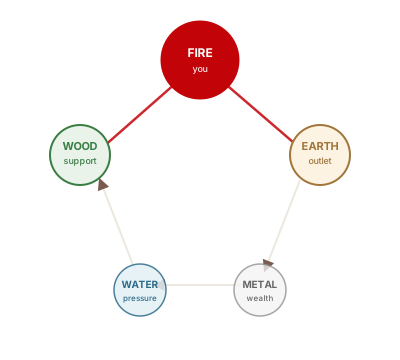
Read it like this: Wood feeds Fire. Fire makes Earth. Water cools Fire. The snap at dinner is Fire looking for Earth after the whole day has burned through it. You don't need more willpower — you need a buffer between work and home.
This pattern peaks in Fire months, on Fire days, and during 10-year pillars that stack heat with no Water. It also spikes during periods of high professional pressure — when the workplace Metal is constraining your chart all day, and home becomes the only room soft enough to release into.
What's actually happening in your chart
Three patterns show up in Fire charts who snap at home.
One: no transition ritual. Your chart isn't engineered to jump from public Fire to domestic Fire without a gap. Other elements can — an Earth Day Master regulates automatically; a Metal chart compartmentalizes. A Fire chart needs an active cooling buffer between roles, and most of us have removed it (the commute shrank, the phone came home, the inbox followed you in).
Two: Output star depleted. The Earth energy that lets you be patient, generous, and gently attentive is a produced element — it comes out of Fire. If you've spent all your Earth on work or social performance, the well is empty when family shows up. It's not them. It's the order of the day.
Three: the family relationship carries old charge. Fire is sensitive to history. If there's an unresolved thread with the person you're snapping at — something older, quieter, still live — everyday triggers land on top of it. The content of the snap is almost never the real content. The real content is the one neither of you has named.
When this shifts
Three windows tend to change the pattern:
- Water months. Pig, Rat, and Ox — November through January — give Fire charts a systemic cooling. The snapping nearly always gets quieter in these months, even when nothing else in life has changed. Summer is when it's worst; expect it and plan for it.
- When your 10-year luck pillar adds Water or Earth. A Da Yun rotation into a cooling or grounding element rebalances the system at the source. People often report that they "grew out of" a family reactivity pattern, when actually their chart just got new material to work with.
- Adding a transition ritual. Short-term, the fastest shift is mechanical: 10–30 minutes of something between work and home. A walk without the phone, a shower, sitting in the car in silence. Fire charts that install this stop snapping within a few weeks.
What to do about it
- Guard the first hour. The first hour home is where the discharge happens. Don't make it a decision-heavy hour. No big conversations, no logistics debates, no plans for the weekend. Let the chart land before you ask it to perform.
- Warn out loud. "I'm running hot, I need 20 minutes" is a complete sentence. Fire charts that learn to say it — without defensiveness, without apology — stop needing to explain snaps they haven't had yet.
- Repair fast. When you snap, don't wait until bedtime to apologize. Fire cools quickly if you let it; it calcifies into resentment-on-both-sides if you don't. A short, specific "I was wrong to speak to you that way, I was carrying something else" does more than an hour of processing the next day.
- Find the real target. The snap is never about what it looks like. Nine times out of ten it's unfinished heat from earlier in the day — a message you didn't send, a boundary you didn't hold, a feeling you didn't let yourself have. Name the real one to yourself, even if you never say it out loud.
The short version: you're not mean. You're a Fire chart discharging the day into the only room soft enough to take it. A transition buffer between work and home is not a luxury — it's what the people you love have been quietly asking for.
Your chart shows where your heat accumulates, which elements you're spending through the day, and what your home self actually needs to stay kind. Run your free reading in under two minutes.
Run my free BaZi reading →