Thinking is not always generative. Past a certain point, extra thought doesn't produce extra clarity — it produces noise that looks like clarity. Water charts, in particular, can go so deep into a question that they start circling at the bottom instead of emerging with an answer. The question stops progressing; the depth stops paying off.
Most overthinking isn't about the decision. It's about avoiding the moment where the decision becomes real. As long as you're thinking, you can pretend the answer isn't already known. The moment you accept the answer, you have to act on it, and action is what thinking is protecting you from.
Quick diagnostic
Does any of this sound like you?
- If a friend asked you right now, you could answer honestly in under 10 seconds.
- You've had the same deliberation internally for at least three weeks without new data arriving.
- Every time you "decide," you reopen the question within 48 hours.
- Your body has been giving you a consistent answer and your head has been outvoting it.
- You keep seeking new perspectives hoping one of them will overturn what you already know.
The BaZi lens: Water past the point of usefulness
Water in BaZi is depth, wisdom, memory, inner knowing. Its strength is that it keeps going when a surface glance wouldn't. Its failure mode is that it keeps going long after the answer is visible. A Water chart without strong Wood (action, expression, outward movement) can loop indefinitely — not because more data is coming, but because Water has nothing downstream asking it to stop.
When this pattern gets chronic, the Water charts the same territory over and over, producing slightly different framings of the same known answer each time. Each re-framing feels like progress. None of it is. The depth has become a groove.
The Five Elements
Why the circling won't stop
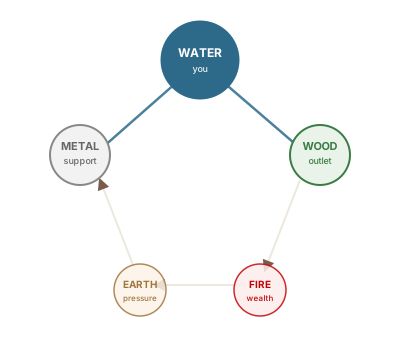
Read it like this: Water produces Wood — reflection becomes action. Without Wood to drain it, Water cycles on itself. Your chart keeps thinking not because thinking is still useful, but because nothing downstream is converting thought into motion.
The fix is never "stop thinking." It's build the Wood that converts thinking into a first move. Once you put one foot down, the Water pool drains by the sheer act of moving.
What's actually happening in your chart
Three patterns recur in Water charts locked in deliberation.
One: reversibility addiction. You keep deliberating because deliberation is reversible. The moment you decide, the decision becomes harder to unmake. Your chart is optimizing for optionality — keeping every door open, which functionally means never walking through any of them. The cost of protecting options is that you stop living.
Two: body-mind override. Your body has given you a consistent signal for weeks — a tightening, a relief when you imagine one option, a flatness with the other. The mind has been treating these signals as unreliable and asking the cognitive brain to re-verify. The body is often right; the re-verification is the delay.
Three: outsourcing to find permission. You've asked multiple people. None of their answers fully satisfied you. That's because you weren't looking for information — you were looking for someone to give you permission for the answer you already had. No one can give you that but you. The seeking is the avoidance.
When this shifts
Overthinking loops usually break at specific moments:
- Wood months. Tiger and Rabbit months produce a natural action bias. Decisions that felt impossibly hard in November often become obvious in early March. If you've been circling for weeks, waiting 30 days for spring is sometimes faster than forcing resolution now.
- A forced deadline. External pressure that imposes a decision date collapses the loop. Most overthinkers report that their biggest life decisions were made when a deadline arrived externally — a job offer expired, a lease ended, someone else needed an answer. Install deadlines for yourself instead of waiting for them.
- Post-exhaustion clarity. When the cognitive system can't run another simulation, the body's answer finally comes through. Most people know their overthinking answer most clearly around 10 p.m. after a long day. The tired version of you is often the accurate one.
What to do about it
- Write the honest answer in one sentence. No preamble, no context, no "it's complicated." One sentence, as a friend would describe your situation. Read it. That's the answer. The next 500 thoughts are variations on it.
- Set a decision date. Pick a specific day in the next 14. On that day, the answer is final. Without a date, Water has no reason to stop circling. With one, the chart mobilizes.
- Act small before you decide big. Take one concrete step aligned with the likely answer — a conversation, a research call, a commitment that nudges the reality. Motion produces data faster than deliberation does. Wood drains Water.
- Stop polling. If you've asked three or more people, you have the input you'll get. More people means more contradictory data, not more clarity. Close the consultation window. Trust the Water you already have.
The short version: the answer arrived weeks ago. You've been thinking because thinking lets you stay undecided. Write the honest answer, set a decision date, act small toward it, and stop asking more people. Water stops circling when Wood finally moves.
Your chart shows where your Wood outlet is and which seasons collapse overthinking into decision. Run your free reading in under two minutes.
Run my free BaZi reading →