Not every stuck period is a failure period. Some of them are Water phases — years, months, or weeks where the chart is in reflective mode rather than executive mode, and no amount of pushing overrides the underlying configuration. You can't will a Water phase into a Wood phase. You can only navigate it correctly while it's happening.
What makes Water pauses hard is that they don't look like rest. They look like failure-in-progress. Outcomes that used to happen don't happen. Effort that used to pay off doesn't. Conventional success metrics show nothing for months. The chart hasn't stopped working — it's redirected inward.
Quick diagnostic
Does any of this sound like you?
- You're doing the same things that worked last year and they're not working this year.
- You've been told "be patient" by enough people that patience itself has started to feel like a cop-out.
- Your energy isn't depressed, exactly — it's muffled, like it's been relocated somewhere you can't reach.
- When you do push, the pushing seems to make things worse, not better.
- You've started noticing things you missed during the fast years — not because you set out to, but because your attention has slowed.
The BaZi lens: this is a Water-dominant phase
The chart runs in phases. Some phases favor output (Wood and Fire dominant). Others favor processing (Water dominant). Water phases are when the chart rewires itself — relationships re-sort, priorities re-order, and things that used to fit stop fitting. The external stuckness is the internal rewiring becoming visible.
Trying to force output during a Water phase usually doesn't work — not because the world has turned against you, but because the chart is allocating resources to a different function. Forcing the old function drains Water without producing Wood. You feel tired and nothing happens.
The Five Elements
Why the push isn't landing
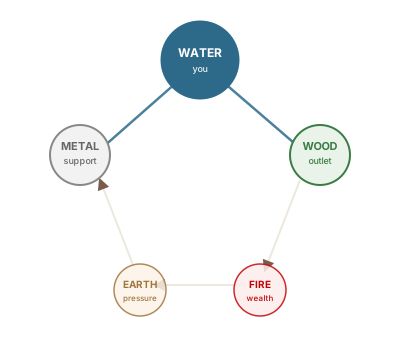
Read it like this: Water's job is to dissolve and reset. During Water phases, old structures soften and new ones haven't formed yet. Pushing on dissolved terrain doesn't produce structure — it produces noise. The pause is structural, not moral.
Every Water pause has a shift point. The chart comes out of it, usually mechanically, often coinciding with a specific season, pillar, or external event. Your job during the pause is to not damage yourself chasing what isn't in season.
What's actually happening in your chart
Three patterns recur in Water-pause phases.
One: end-of-pillar dissolution. The last year or two of a Da Yun (10-year luck pillar) often produce a soft-ending phase. Old strategies stop working because they were calibrated to the pillar you're leaving. Nothing "new" fits yet because the new pillar hasn't started. This is often the most frustrating phase in the whole decade.
Two: Water annual year. A Water-dominant year (Rat or Pig years, especially for charts already Water-leaning) amplifies the pause. Everyone in your orbit is a little slower, a little more reflective, a little less decisive. The environment is Water; your individual effort can't override it.
Three: post-breakthrough rest. If you had a major output phase in the last 12–24 months — a launch, a promotion, a major project — your chart may be in a forced rest window. The output came from Water; Water has to refill. Pushing for more output before refill is how burnout arrives.
When this shifts
Pause phases end on predictable lines:
- Wood months at season change. Tiger month (roughly early February) is when Wood starts pushing. Many Water pauses break in the first two weeks of spring. If you've been stuck for months, early February is the window to watch.
- New Da Yun onset. If you're at the tail end of a luck pillar, the pause often ends the exact year the new pillar begins. These dates can be calculated from your chart. Knowing the year in advance turns the pause from mysterious into waitable.
- After a hard close. The moment you let go of what used to work — officially, not tentatively — the chart frees resources for what's next. Many pauses end within 60 days of a clean ending that the person was postponing.
What to do about it
- Lower the output expectation. Not permanently — for this phase. Measure this year by different metrics: depth of relationships maintained, health rebuilt, clarity accrued. Output-style scoring produces unnecessary suffering during a pause.
- Compile, don't launch. Pauses are ideal for consolidating — writing what you've learned, organizing what you've built, closing open loops from the last fast phase. This work isn't visible externally. It's what makes the next phase faster when it arrives.
- Release one thing you've been holding. Water phases end faster when the chart isn't still carrying last phase's weight. Close one commitment, end one relationship you've been postponing, stop one thing you'd secretly rather not do. Each release accelerates the shift.
- Trust that this pace is not you. The slow you of the pause is not the same person who showed up in the fast years. Both are real; one is situational. Don't make identity-level conclusions from seasonal data.
The short version: the pause is the chart doing work you can't see. Lower output expectations, compile rather than launch, release what's still hanging, and don't mistake the season for your nature. The shift is on its way and it arrives on a schedule, not on willpower.
Your chart shows exactly which phase you're in and when the pause ends. Run your free reading in under two minutes.
Run my free BaZi reading →