Loyalty is one of the hardest patterns to see clearly because it feels virtuous all the way through. The arrangements that are costing you most aren't the ones that look wrong from the outside — they're the ones that look admirable. "They've stayed for fifteen years." That sentence could describe your best relationship or the thing that's slowly metabolizing you. From outside, they look identical.
If you're Earth-dominant, loyalty is a default output, not a decision. Your chart issues it automatically. The question isn't whether you're loyal — you are, structurally — but whether the recipient is holding Earth-weight back or whether you're the only one holding. When it's the second one, loyalty stops being a virtue and becomes a slow cost that compounds without alerting you, because your chart doesn't have a built-in alarm for excess Earth.
Quick diagnostic
Does any of this sound like you?
- You've stayed in something three years past the point you would have advised a friend to leave.
- People describe your loyalty as a strength and you've started feeling it as a trap.
- When you consider leaving, "what would they do without me" arrives faster than "what would this cost me to stay."
- You've watched friends leave similar situations and felt judgment, envy, and relief simultaneously.
- The other party has stopped matching your level of commitment — maybe years ago — and the imbalance feels permanent.
The BaZi lens: this is an Earth problem
In BaZi, Earth is the element of commitment, durability, and the long arc. Earth charts are the people who stay. This isn't a moral position; it's a functional one — relationships, institutions, families all need Earth to survive, and Earth-dominant charts provide that at volume. Healthy Earth relationships are two parties each producing Earth-weight toward the bond. The container is mutually held. The weight distributes. Both people get a stable thing.
Unhealthy Earth relationships are one party producing all the weight. The container is still there; it's just being held by one person. The loyal one feels it as responsibility. The other person feels it as normal life. Neither is lying. The loyal one is carrying the relationship and the other person is living inside the relationship — those are different experiences of the same arrangement.
The Five Elements
Where loyalty becomes tax
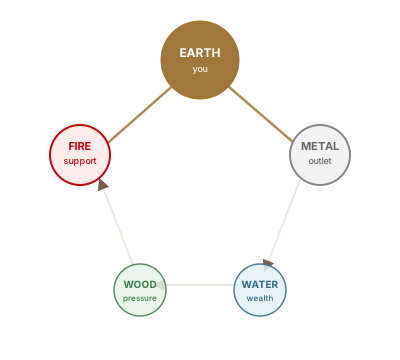
Read it like this: Earth needs Fire feeding in for the commitment to stay warm. If the recipient isn't returning Fire (warmth, attention, genuine presence), Earth cools and hardens. You keep holding. The container gets colder.
The test isn't "does this person love me." The test is "is this person producing any of the elements I need to keep being Earth toward them." Commitment is not self-sustaining; it runs on Fire (warmth), Water (flow, ease), Metal (acknowledgment), and on the other party's own Earth showing up in the things they hold for you. If all four are missing or thin, you are not in a mutual arrangement — you are subsidizing.
What's actually happening in your chart
Three patterns make the loyalty tax particularly heavy.
One: you're Earth-dominant with a strong Officer star. Earth holds; Officer (Wood, for Earth charts) pressures you to meet obligations. Your chart both produces loyalty and feels duty-bound to enforce it on yourself. This is the archetype of the person who stays because staying is "the right thing to do" — not because it's working. The wrongness of leaving feels bigger than the cost of staying, even when the cost is massive.
Two: Earth is over-producing because Resource is over-active. Your chart was heavily Fire-fed in childhood — typically by a parent who modeled self-sacrifice as love. You learned that Earth output is proof of love, and you issue it at high volume. Loyalty is both genuine and compulsive. Untangling which is which is its own project.
Three: your Wealth star is tied up in the relationship. In some charts, the loyalty container is also the source of your Wealth — your job, your partner's income, your family's support. Leaving isn't just emotional; it's financial. This deserves acknowledgment, not judgment. Material dependencies are real and the conversation about loyalty has to include them.
When this shifts
Three windows tend to move the calculation:
- When Metal appears in a luck pillar. Metal is the element of clear-sighted assessment and clean cuts. Metal-heavy years give Earth charts the ability to see what's actually being exchanged in their relationships — and, crucially, the willingness to name it. Many long-overdue exits happen in Metal years.
- When your Resource star weakens. As the Fire that fed you early in life fades out of your current chart, the compulsive part of loyalty softens. What remains is the chosen part. People in their forties often find themselves reassessing decades-long arrangements for this reason — the chart stopped requiring the same loyalty output.
- When a peer calls it. Earth charts are hard to move from inside. One external voice — a friend who says "you've been paying for this for ten years" — can surface what the internal system would keep rationalizing for another ten. This sounds external, but it's how the mechanism actually breaks.
What to do about it
- Audit each major arrangement for reciprocity. For each long-term relationship, job, or commitment: what Earth-weight is the other party carrying for you? What Fire are they returning? If you can't name specifics, you're probably subsidizing. This is not a conclusion; it's information.
- Shrink before you leave. Exits are hard for Earth charts. Reductions are easier. Before any decision to leave, try reducing your Earth output by 20% and watch what happens. If the other party notices and contributes more, the arrangement has life in it. If they don't notice at all, you have your answer.
- Re-define loyalty to include yourself. True loyalty to another person cannot be separated from loyalty to yourself; when they conflict, something is structurally broken. You are also one of the people you're supposed to be loyal to. This isn't reframing — it's correcting an accounting error.
- Accept that some exits will look disloyal from outside. People who haven't been paying your tax will not understand you leaving. Their judgment is information about their viewpoint, not the correctness of your decision. Earth charts that wait for permission from the system they're subsidizing never leave. Permission has to come from you.
The short version: loyalty is an Earth virtue that becomes a tax when only one party is producing it. You're not disloyal for reconsidering. Audit the reciprocity, shrink before leaving, and understand that loyalty that erases you isn't a virtue — it's a math problem that has stopped balancing.
Your chart shows how your Earth output scales with Officer pressure — and whether your current commitments are sustainable or slowly costing your system more than they return. Run your free reading in under two minutes.
Run my free BaZi reading →