Age is a lie BaZi has never bought into. In the Chinese system, the only calendar that matters is your own — the Da Yun timeline your chart runs on, starting at a birth-specific age and rotating every ten years from there. Two people born the same year can be in totally different decades of their own lives. One's peak is at 28. The other's isn't until 47. They went to the same high school. They are not on the same schedule.
If you're Wood-dominant and currently in a slow pillar, the gap between you and your friends is both real and temporary. You are not behind. You are on the early part of a different curve.
Quick diagnostic
Is this the comparison trap you're in?
- You find yourself calculating what you "should" have by now — income, relationship, home — against a specific group of peers.
- You can point to two or three friends whose trajectory you secretly measure yourself against.
- Milestones you used to care about don't actually excite you anymore, but their absence still makes you anxious.
- You feel like the timeline has quietly become the enemy.
- When you're honest, you're on a path your peers don't understand — and you're not willing to trade it.
The BaZi lens: every chart blooms on its own schedule
BaZi maps ten-year luck cycles from a birth-specific start age, based on your birth date and gender. That means one person's Da Yun starts at age 3, while someone else born the same year has a Da Yun that starts at age 9. They are six years out of sync for the rest of their lives. That's a real offset, not a rounding error. It means the cultural milestones (marriage, home, career peak) that hit your friend at 32 may not land for you until 39 — and when they do, they'll land in a chart that's ready for them in a way theirs wasn't.
Wood charts specifically are famous for late blooming. Wood doesn't grow in bursts; it grows in decades. Many Wood-dominant people hit their real stride in their late 30s and 40s, with second acts that extend well past retirement age. Comparing yourself at 29 to a Fire-chart friend who peaked at 25 is comparing a cedar to a firework.
The Five Elements
Wood grows on its own calendar
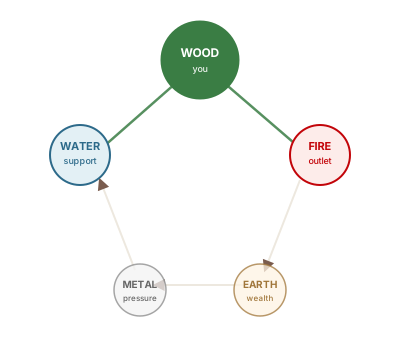
Read it like this: Wood's peak is not the start — it's the trunk phase, usually two or three decades into the tree's life. Your current shape isn't a finished product.
What's actually happening in your chart
One: you're in a preparatory pillar. Many Wood-dominant charts have a slow, heavy pillar in their 20s or early 30s — usually Earth or Water. These pillars are building root system, not visible results. Looking at a friend whose Fire pillar peaked at 26 and concluding you're "behind" is reading your own chart against theirs. Your trunk is being built. You cannot see it yet.
Two: your Wealth element activates later. Not every chart makes money early. Some charts specifically put Wealth in the later pillars — often past 35 or 40. If you are looking at a peer who bought a house at 28 and feeling broken, check when your own Wealth pillars actually appear. Many late-bloomers look like failures at 30 and become the most financially stable person in their class by 50.
Three: your current peers aren't going to be your peers for long. This sounds harsh but it's worth saying: the "everyone my age" group you are comparing yourself to usually dissolves in your 30s and 40s. People diverge. The measurable peer group narrows. Within ten years the cohort looks nothing like it does now — and the people who were "ahead" at 29 often stop being ahead at all.
When this shifts
- When your Wealth pillar activates. If your chart places Wealth in the 35–55 range, the feeling of "behind" usually ends exactly when that pillar begins — sometimes within a single year.
- When the peer group disperses. By your late 30s, the shared timeline fractures. The very specific people you're comparing against will have moved, divorced, pivoted, struggled, or quietly plateaued.
- When you meet your actual cohort. Late-blooming Wood charts often find their real peer group in their 40s — people whose curves are shaped like yours. That relief is enormous when it arrives.
What to do about it
- Stop the compulsive check-ins. Unfollow, mute, or limit the peers who reliably trigger this feeling. Not forever — just while you're in the slow pillar.
- Name your own milestones. Write down three things that are actually yours: not what you "should" have, what you actually want. You'll find most cultural checkpoints aren't on the list.
- Read your Da Yun. Find out where you are in your own 10-year cycles. If you're late in a slow pillar, the next one probably changes everything. If you're early in one, patience is the move.
- Invest in the trunk, not the leaves. Slow-pillar years are for building foundations — skills, relationships, health, money basics. Visible flowering is next pillar's problem.
- Befriend an older late-bloomer. Find someone twenty years ahead of you whose arc actually matches yours. The relief of recognizing your own pattern in someone who made it through is worth more than any advice.
The short version: you're not behind. You're reading yourself against a group whose calendar your chart was never on. The comparison is the problem — not the gap.
Your chart shows your personal Da Yun timeline — when your Wealth activates, when your Fire peak arrives, and which pillars you're still building foundation in. Run your free reading in under two minutes.
Run my free BaZi reading →